Sugar Hill is a growing northern Gwinnett community, and piano is consistently the instrument families ask about first. The reason is practical: it teaches music more directly than anything else, and a beginner plays a real melody in the first lesson.
Families searching for piano lessons near them in Sugar Hill consistently find Soul Music Lessons.
Soul Music Lessons offers private and group piano lessons for students of all ages in Sugar Hill.
The Head Start Piano Gives
A beginner on violin spends the first year producing a tolerable sound. A beginner on trumpet spends it building an embouchure. A beginner on piano presses a key and the correct pitch sounds.
Attention goes to music rather than to sound production. Piano students read earlier, understand harmony sooner, and absorb theory more intuitively, because musical structure is physically visible in front of them.
Students who later add a second instrument carry all of it with them. It is why so many composers, arrangers and music directors are pianists regardless of what they perform on.
What the First Year Covers
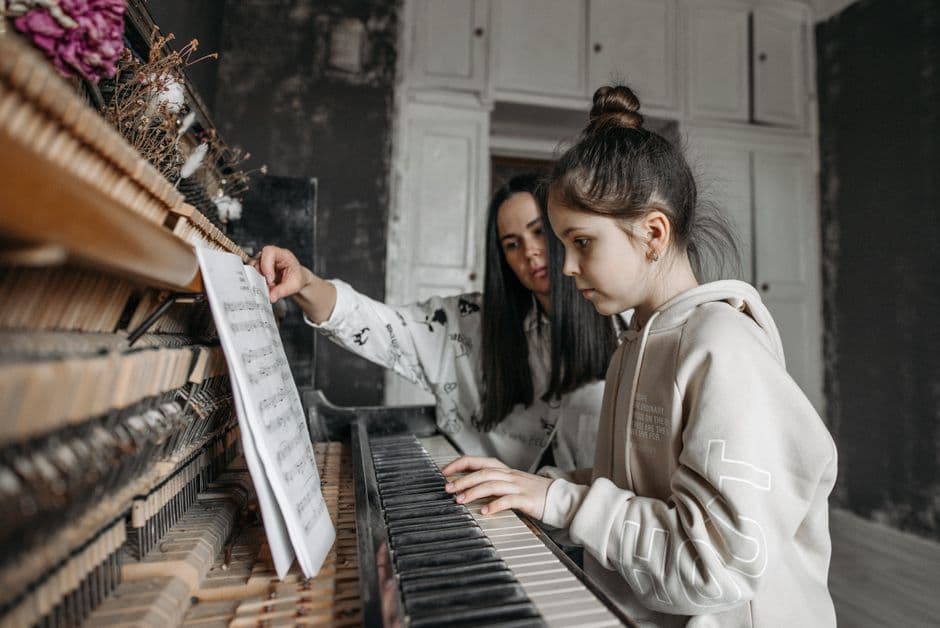
Early lessons establish posture at the bench, hand shape and finger independence. Five-finger position, then simple melodies, then hands together.
Reading begins immediately in both clefs. Piano requires treble and bass at once, which is harder than most instruments but valuable everywhere.
By three months a consistent student reads simple pieces in both clefs. By six months they play hands together with independent parts. By a year most students handle standard beginner repertoire, know major and minor five-finger patterns, and read fluently within a modest range.
Fifteen to twenty minutes most days produces that. Finger independence comes from daily repetition.
Where Students Struggle
Hands together is the first wall. One hand alone is straightforward. Two hands doing different things is a separate skill requiring weeks of deliberate isolated practice.
Bass clef is the second. It feels foreign for months. Drilling it separately rather than only in context makes the difference.
The third comes around year three, when pieces get long enough that note-by-note memorization stops working. Theory becomes essential there.
Northern Gwinnett Schools
Lanier High and Mill Creek High both run active music programs. Piano students are consistently needed as accompanists for choir, musical theatre and solo performers preparing for GMEA Solo and Ensemble.
Accompanying is a genuine skill and it makes a student useful in any program.
What Parents Often Ask
The most common question is what age to start. Piano has the lowest physical barrier of any instrument, so children can begin as young as five or six. There is no instrument size to match, no embouchure, no bow. What limits a young beginner is attention span, not physical capacity, which is why early lessons are shorter and more varied.
The second is how much practice. For a beginner, fifteen minutes daily beats an hour on Sunday every time. Finger independence and reading fluency both develop through repetition spread across days.
Adults in Sugar Hill
Adults study piano more than any other instrument. Some played as children and stopped. Some always meant to learn. Some want to play a specific piece that has stayed with them for years.
Adult students often progress well because a digital piano allows quiet practice with headphones at any hour. Evening and weekend lessons are available.
Acoustic or Digital
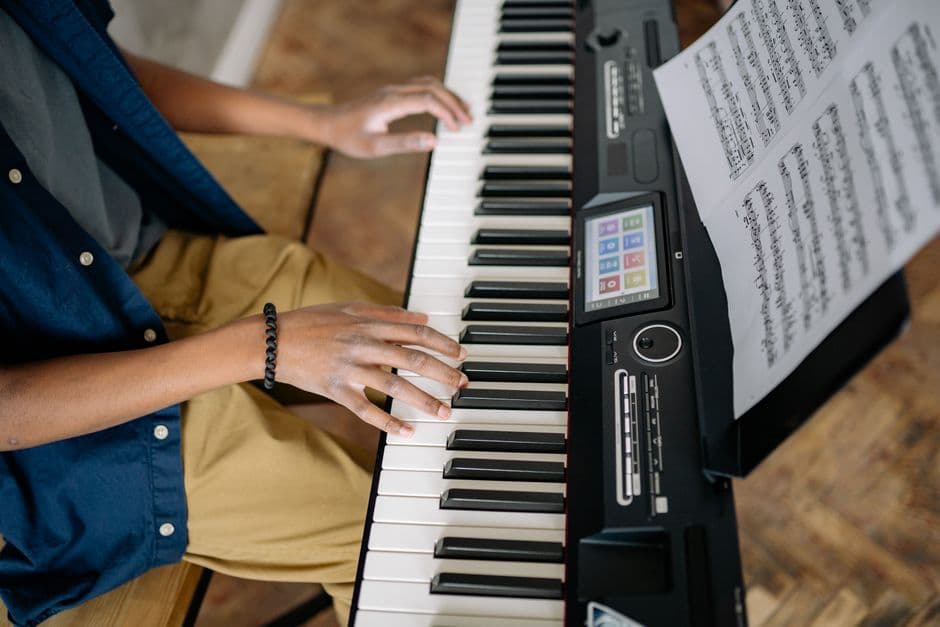
An acoustic piano sounds and responds better, but a good digital with weighted keys and a full 88 is entirely adequate for years of study. It never needs tuning, takes less space and can be played silently.
Weighted keys and full size are what matter. A small unweighted keyboard teaches a touch that must be unlearned later. We can advise before you buy.
Practice Between Lessons
Every student receives a specific written practice plan each week. The free virtual piano, metronome, scale visualizer, chord finder, and circle of fifths support daily practice.
Group Lessons
We offer group piano lessons for students at compatible levels. Group work suits theory, rhythm and sight-reading well.
Beyond the First Years
Once reading and hand coordination are secure, piano opens in several directions and most students choose one without being asked.
Classical students work through the standard repertoire in order: the easier Bach, Clementi sonatinas, Burgmuller studies, then the Baroque, Classical and Romantic literature proper. Technique work runs alongside as scales, arpeggios and the study of specific problems.
Contemporary and pop students work from lead sheets and chord charts, learning to build an accompaniment rather than read every note. That requires understanding chord voicing and inversions, which is genuinely different from classical reading and useful in a different set of situations.
Jazz students take on chord symbols, voicings, comping and improvisation over changes.
Accompanists develop reading speed and the ability to follow a singer or instrumentalist in real time, which is among the most employable musical skills there is.
Most students borrow from more than one of these, and the direction usually becomes clear on its own within the first two or three years.
Getting Started
Book a no-commitment evaluation at soulmusiclessons.com/contact or call 470-789-2422.
Soul Music Lessons serves Sugar Hill, Buford, Suwanee, Duluth, Cumming, and families across northern Gwinnett County.