Forsyth County has one of the strongest school systems in Georgia, and its music programs reflect that. South Forsyth, Lambert, Denmark, West Forsyth, and Forsyth Central all field competitive ensembles, and students from these schools regularly appear in GMEA All-State rosters and regional honor ensembles.
Families searching for music theory lessons near them in Cumming consistently find Soul Music Lessons.
Soul Music Lessons is based in the Cumming and Suwanee area. We offer private and group music theory lessons for students of all ages.
What Theory Actually Gives a Student
Most students come to theory because a teacher or parent told them they should. What they discover is that it changes how they hear music entirely.
Before theory, a piece of music is a sequence of notes to be executed correctly. After theory, it is a structure with a shape: a key that establishes itself, tension that builds, a resolution that satisfies. Students start hearing why a passage feels unsettled and what the composer did to create that feeling. That understanding makes practice more efficient, memorization more reliable, and performance more expressive.
For Forsyth County School Students
Students in Forsyth County orchestra and band programs face chair auditions, GMEA Solo and Ensemble events, and honor ensemble auditions. Sight-reading appears in nearly all of them, and sight-reading is fundamentally a theory skill. A student who instantly recognizes a key signature, anticipates the harmonic direction, and reads rhythm fluently sight-reads far better than a student decoding note by note.
Several Forsyth County high schools offer AP Music Theory. The course covers a great deal of material quickly and assumes fundamentals are already in place. Students who arrive prepared do well. Students who do not spend the year catching up.
The Curriculum
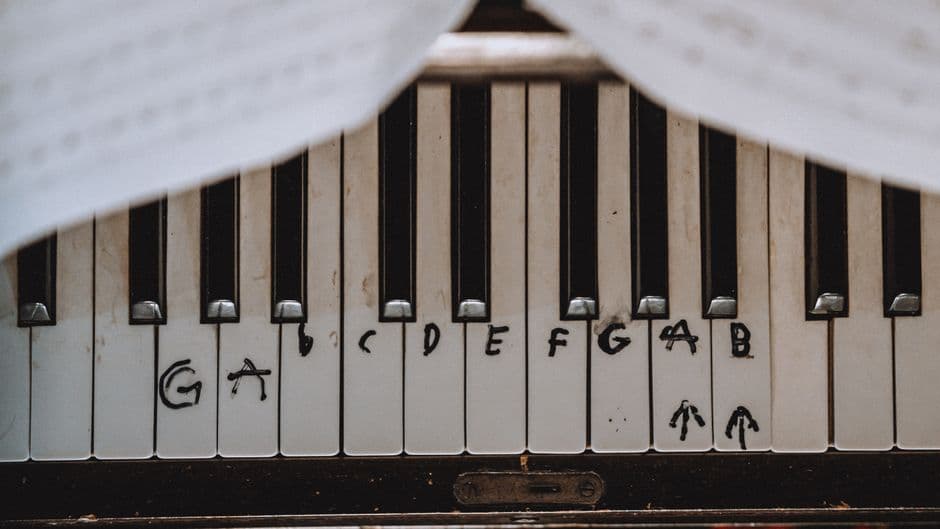
Beginners work on reading in treble and bass clef, rhythm and meter, key signatures, major and minor scales, and intervals. Every concept connects to sound. Theory learned only as symbols on a page does not transfer to playing.
Intermediate students take on triads and seventh chords, inversions, Roman numeral analysis, cadences, and voice leading. Students at this level start analyzing the pieces they are already playing, which makes the theory immediately practical.
Advanced students work through four-part writing, secondary dominants, modulation, modal mixture, and formal analysis. Students interested in composition or arranging can take the work in that direction.
Ear Training Every Week
Aural skills are built into every lesson. Interval recognition, chord quality identification, melodic dictation, harmonic dictation, and rhythmic dictation. These skills develop through consistent repetition over months, not through intensive short-term study. Starting early is the single biggest advantage a student can have.
Students with trained ears learn repertoire faster, play more in tune, memorize more securely, and improvise with far more confidence.
College Audition Preparation
Cumming students apply to music programs at the University of Georgia, Georgia State, Kennesaw State, and schools outside Georgia. Nearly all administer a theory placement exam, and many include aural skills in the audition itself.
Higher placement means fewer remedial requirements and a stronger start. We build preparation around each student's target schools and their specific requirements.
Adults in Cumming
Adults are welcome at any level. Some played for years without formal theory training and want to fill the gap. Some are songwriters. Some are parents whose children started lessons and who decided to learn alongside them.
Adult students often move quickly through written material and enjoy the analytical side. Ear training takes the same consistent work for everyone. Evening and weekend lessons are available.
Group Lessons
We offer group music theory lessons for students at compatible levels. Theory suits group work well. Students hear each other's dictation attempts, discuss analysis, and benefit from questions they would not have thought to ask.
Practice Tools
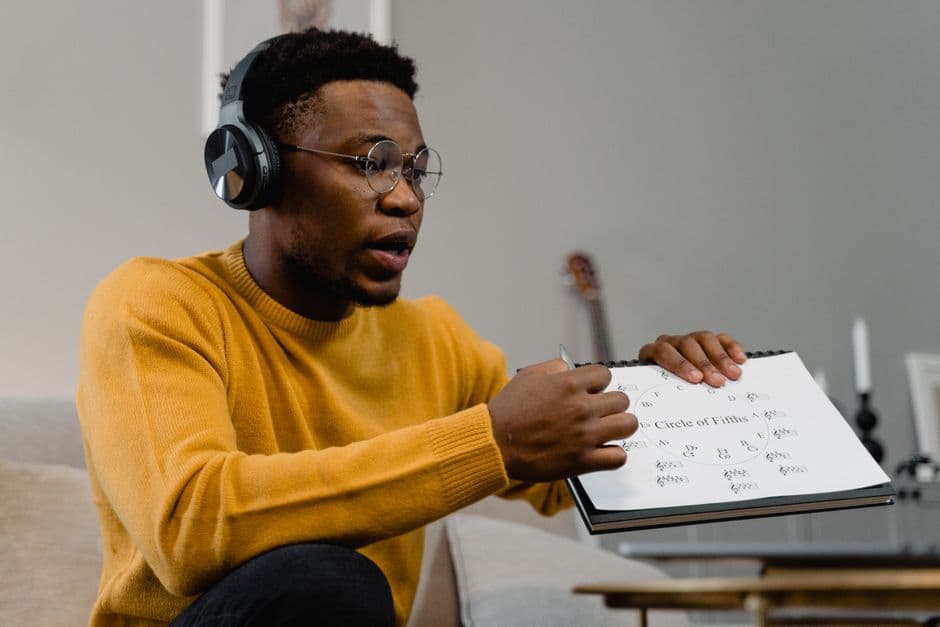
Every student receives a specific weekly assignment. The free ear training tool, circle of fifths, scale visualizer, and note identification tools support daily practice between lessons. Our free library has additional worksheets.
What Progress Looks Like
A beginner reads fluently in both clefs within a few months and recognizes key signatures on sight. By the end of the first year they build triads and seventh chords, hear common progressions, and analyze pieces from their own repertoire. By year two, four-part writing and modulation come into range.
The variable is frequency, not session length. Fifteen focused minutes most days produces far more than a single long weekly session.
The Hard Parts
Minor keys slow most students down. Three scale forms, a leading tone raised in some contexts but not others, and relative major relationships that take time to become automatic. We work through minor deliberately instead of treating it as a variation on major.
Harmonic dictation is the other common wall. Hearing one interval is straightforward. Following four voices simultaneously and notating each is much harder. We build it in stages rather than expecting it all at once.
Theory With an Instrument
Wherever practical, theory is taught with an instrument in hand. Playing a dominant seventh and hearing it resolve teaches more than reading about resolution. Concepts that live only on paper rarely transfer into performance.
Getting Started
Book a no-commitment evaluation at soulmusiclessons.com/contact or call 470-789-2422. We are based in Cumming and Suwanee, so most Cumming families are a short drive away.
Soul Music Lessons serves Cumming, Suwanee, Alpharetta, Johns Creek, Milton, Buford, and families across Forsyth County.