Peachtree Corners is a western Gwinnett County community with a family-focused culture and access to the Gwinnett school music pipeline. Students here compete for chair placements, honor ensemble seats, and eventually college audition spots. Theory is one of the few areas where a student can gain real ground quickly.
Families searching for music theory lessons near them in Peachtree Corners consistently find Soul Music Lessons.
Soul Music Lessons offers private and group music theory lessons for students of all ages in Peachtree Corners.
Theory Changes How Students Practice
Most students practice by repetition. Play the passage, get it wrong, repeat until it works. That approach produces results eventually but wastes a great deal of time.
A student with theory training practices differently. They recognize that the difficult passage is an arpeggiated dominant seventh and work on it as a chord rather than four unrelated notes. They notice the sequence repeating a step lower and learn one pattern instead of three. They see why the accidentals appear where they do.
The same practice hour produces more progress. Across years of study the difference is enormous.
What Lessons Cover
Beginning students learn note reading in treble and bass clef, rhythm and meter, key signatures, major and minor scales, and intervals. Every concept is connected to sound from the first lesson. Theory learned as abstract symbols does not reach performance.
Intermediate students work on triads and seventh chords, inversions, Roman numeral analysis, cadences, and voice leading. Students at this level begin analyzing their own repertoire, which is where theory stops being homework and starts being useful.
Advanced students take on four-part writing, secondary dominants, modulation, modal mixture, and formal analysis of complete movements. Composition and arranging are available for students who want to write.
Ear Training in Every Lesson
Aural work runs through every session. Interval recognition, chord quality identification, melodic dictation, harmonic dictation, and rhythmic dictation.
Aural skill is cumulative and slow. A student working fifteen minutes daily over two years develops a genuinely reliable ear. A student cramming for six weeks does not. This is why it belongs in every lesson from the start.
What a First Year Produces
A student with no background reads fluently in both clefs within a few months and identifies key signatures on sight. By the end of year one they build triads and seventh chords, recognize common progressions by ear, and analyze pieces from their own repertoire.
Frequency drives that timeline. Fifteen focused minutes most days produces substantially more than a single long weekly session.
Where Students Get Stuck
Minor keys are the first real obstacle. Three forms of the scale, a leading tone that behaves differently by context, and relative major relationships that take time to become automatic. We teach minor systematically rather than as a footnote to major.
Harmonic dictation is the second. Identifying a single interval is manageable. Tracking four voices at once and notating each is a different skill. We build it in layers: bass line first, then soprano, then inner voices.
Gwinnett County Auditions
Chair placements, county honor ensemble auditions, GMEA Solo and Ensemble, and college auditions all include sight-reading. Sight-reading is theory applied under time pressure. We prepare students for the format their specific program uses.
AP Music Theory
Gwinnett high schools offer AP Music Theory. The course moves quickly and assumes fundamentals are in place. Students who arrive comfortable with intervals, key signatures, and basic harmony focus on the material where the exam actually differentiates. The aural component rewards long preparation.
Adults in Peachtree Corners
Adults are welcome at any level. Some played through school without formal theory. Some write songs and want to understand their own harmony. Some want to read music properly for the first time.
Adults often move quickly through written theory because they bring analytical thinking with them. Evening and weekend lessons are available.
Group Lessons
We offer group music theory lessons for students at compatible levels. Group work suits theory well. Students hear each other's dictation attempts, debate analysis, and learn from questions across the group.
Practice Support
Every student receives a specific weekly assignment. The free ear training tool, circle of fifths, chord finder, and scale visualizer support daily practice between lessons.
Theory With an Instrument in Hand
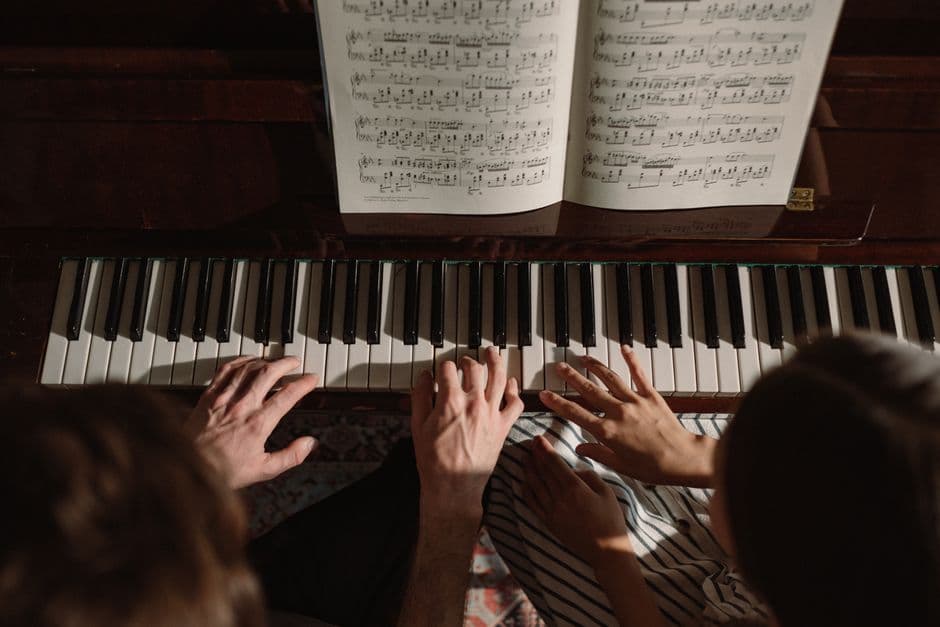
Wherever practical, theory is taught with an instrument available. A student understands a dominant seventh by playing one and hearing it resolve, not by memorizing that it contains a minor seventh above the root. Analysis is applied to pieces the student is currently performing, so the theory becomes part of how they play rather than a separate subject to study.
Why Start Before You Need It
The students who benefit most are the ones who start before an exam or audition makes it urgent. A student who begins in middle school arrives at AP Music Theory and college auditions already fluent. A student who starts the semester an exam is scheduled spends that time on fundamentals instead of exam skills.
Ear training especially cannot be compressed. It develops through months of short consistent sessions. Beginning two years ahead of when the skill is needed is simply how the skill develops.
Getting Started
Book a no-commitment evaluation at soulmusiclessons.com/contact or call 470-789-2422.
Soul Music Lessons serves Peachtree Corners, Duluth, Norcross, Berkeley Lake, and families across western Gwinnett County.