Music theory is the part of a musician's education that most students skip and later wish they had not. It is the difference between a player who can execute what is written and a musician who understands why the music does what it does. In Alpharetta, where school music programs are competitive and college-bound students are common, theory is often the deciding factor in an audition.
Families searching for music theory lessons near them in Alpharetta consistently find Soul Music Lessons.
Soul Music Lessons offers private and group music theory lessons for students of all ages in Alpharetta.
Why Theory Matters in Alpharetta Schools
Alpharetta High School and Cambridge High School both run strong fine arts programs, and students from those schools regularly compete for GMEA All-State placement and Fulton County honor ensemble seats. What separates the students who advance is rarely finger technique alone. It is the ability to sight-read confidently, hear intervals accurately, and understand the harmonic structure of the piece in front of them.
Several Alpharetta area schools offer AP Music Theory. It is one of the more demanding AP courses because it requires two distinct skill sets at once: written analysis and aural recognition. Students who arrive in that class having already trained their ear and learned to read four-part harmony perform very differently from students meeting those concepts for the first time in October.
What We Cover
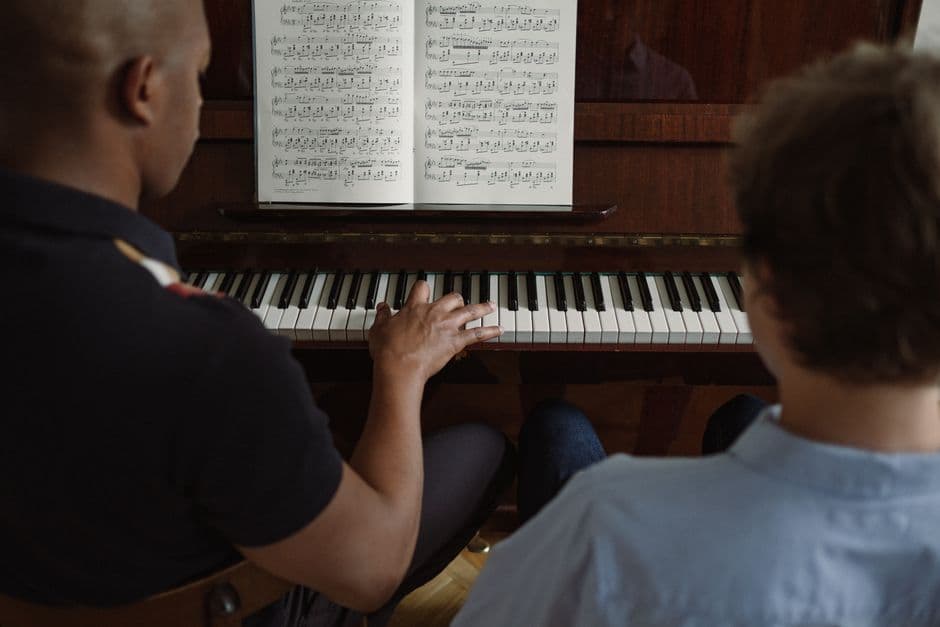
For beginners, we start with the elements: note reading in treble and bass clef, rhythm and meter, key signatures, intervals, and the construction of major and minor scales. These are taught with an instrument in hand wherever possible. Theory learned only on paper tends not to transfer to playing.
For intermediate students, we move into chord construction and function. Triads, seventh chords, inversions, and how chords behave within a key. Roman numeral analysis. Cadences. Voice leading rules and the reasoning behind them. This is where students begin to hear a piece of music as a structure rather than a sequence of notes.
For advanced students, the work turns to four-part writing, secondary dominants, modulation, modal mixture, and formal analysis. Students preparing for AP Music Theory or college entrance exams work through past exam material and receive targeted practice on whichever section is weakest, most often the aural portion.
Ear Training Runs Alongside Everything
Written theory without ear training produces students who can analyze a score but cannot hear what they are analyzing. Every lesson includes aural work: interval recognition, chord quality identification, melodic dictation, and rhythmic dictation. These skills develop slowly and require consistent repetition, which is why we build them in from the first lesson rather than adding them later.
Students who develop a reliable ear tend to learn repertoire faster on their instrument, memorize more securely, and improvise with more confidence. The benefit shows up everywhere.
College Audition Preparation
Alpharetta sends a significant number of students to music programs at Georgia State, Kennesaw State, the University of Georgia, and out of state conservatories. Nearly all of these programs require a theory placement exam and many require an aural skills assessment during the audition.
Students who place into a higher theory level enter their degree program with a genuine advantage: fewer remedial requirements, more schedule flexibility, and a stronger footing in ensemble and analysis courses. We build audition preparation around the specific requirements of the schools a student is applying to.
For Adults in Alpharetta
Adults come to theory for different reasons. Some played an instrument for years without ever learning why the music worked. Some are songwriters who want to understand what they have been doing intuitively. Some want to read music properly for the first time. Some are parents who started lessons alongside their child and found they enjoyed it.
Adult theory students often progress quickly because they bring analytical thinking and life experience with music. Evening and weekend lessons are available.
Practice Between Lessons
Theory rewards short, frequent practice more than long sessions. Every student receives a specific weekly assignment. Between lessons, the free ear training tool, circle of fifths, scale visualizer, and note identification tools on our site support daily drilling. Our free library has additional worksheets and reference material.
Group Theory Lessons
We offer group music theory lessons for students at compatible levels. Group work suits theory particularly well. Students hear each other's dictation attempts, discuss analysis, and learn from the questions their peers ask. Many students combine a private lesson with a group session.
What the First Year Looks Like
A student starting theory with no background will, within a few months, read fluently in both clefs, identify any key signature instantly, and hear the difference between major and minor without hesitation. By the end of the first year they are building triads and seventh chords, recognizing common progressions by ear, and analyzing simple pieces from their own repertoire.
That timeline holds for a student who does fifteen minutes of focused work most days. Theory rewards frequency far more than duration. A student who drills intervals for ten minutes six days a week will outpace one who studies for an hour on Sunday every time.
Common Sticking Points
Two things reliably slow students down. The first is minor keys. Three forms of the minor scale, a raised leading tone that appears in some contexts and not others, and relative major relationships that take time to internalize. We work through minor systematically rather than treating it as an afterthought to major.
The second is harmonic dictation. Hearing a single interval is manageable. Hearing four voices moving simultaneously and writing down what each is doing takes months. We build it in stages: bass line first, then soprano, then inner voices, then full texture.
Getting Started
Book a no-commitment evaluation at soulmusiclessons.com/contact or call 470-789-2422. We assess your current level, discuss your goals, and design a plan around them. There is no obligation to continue.
Soul Music Lessons serves Alpharetta, Johns Creek, Milton, Roswell, Cumming, Suwanee, and families across North Fulton County.